

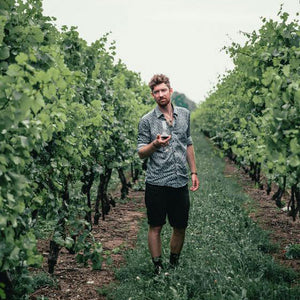

This historic parcel of dry-farmed bush vine Cinsault is planted on an ancient riverbed in Wellington, rooted in deep sandy alluvial soils that contribute both lifted aromatics and structural poise. Established in 1900 on some of the first rootstocks introduced to South Africa, it is recognised as the country’s oldest registered red wine vineyard. Now approaching a decade of careful rehabilitation through sustainable farming, the vineyard continues to show marked qualitative improvement with each vintage. The 2022 harvest took place by hand in the cool morning hours of 18 February, yielding approximately four tons per hectare (around 20 hl/ha), reflecting the low-yielding nature of this heritage site.
Vinification was undertaken with a focus on preserving site character and natural tannin profile. One hundred percent crushed whole clusters were placed in tank with minimal sulphur addition and no further inputs. Fermentation commenced spontaneously, with gentle pigeage applied as required. Temperatures were managed on the cooler side to moderate Cinsault’s naturally rapid fermentation and retain aromatic purity. Following three weeks of extended maceration, the wine was drained and pressed to 500L French oak barrels, where it matured for 21 months.
In the glass, the wine shows pronounced aromatic lift — rose petal, thyme and pomegranate — underpinned by red berry fruit. The palate is silky and finely layered, with delicate yet persistent tannins providing structure and clarity. As it evolves in bottle, the texture deepens and broadens, rewarding patient cellaring.
